Hampden Avenue Quilt Pattern
DESIGNER: Unknown
OWNED BY: Susan Guzman
DIFFICULTY LEVEL ‣ BEGINNER
FINISHED QUILT SIZE:
63½” x 72½”
FINISHED BLOCK SIZE:
9″ x 9″
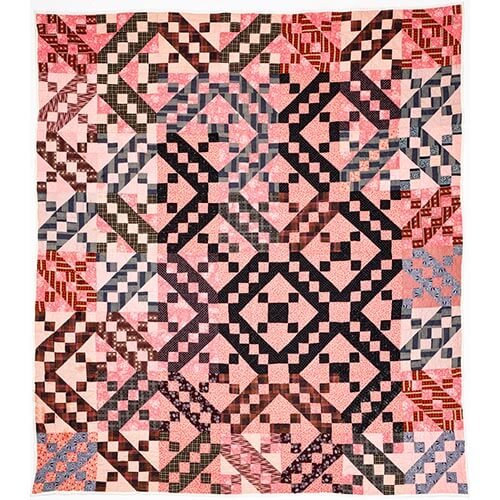
Hampden Avenue features Jacob’s Ladder blocks. The block name comes from the Biblical account of Jacob’s dream in Genesis, in which he saw a ladder stretching from heaven to earth. Some quilt historians believe the pattern dates before the Revolutionary War. It appealed to many quilters for its religious meaning and remains popular to this day. This antique example likely dates to the late 1800s. When blocks are joined together, they form a lovely intersecting pattern that also resembles avenues, which inspired our quilt’s name.
Instructions:
SPECIAL INSTRUCTIONS:
Read through entire pattern before beginning project. Use ¼” seam allowances with fabric right sides together. Pressing arrows are included with diagrams. Basic quiltmaking supplies are assumed. Fabric requirements include extra yardage for shrinkage and insurance. If working with directional prints, you may want to purchase more fabric than called for. Pattern is based on an antique quilt and has been simplified as needed for ease of construction and may differ slightly from original.
WOF = width of fabric
LOF = length of fabric
HST = half-square triangle
FABRIC:
Fabric A: 3¼ yards total assorted pink fabric
Fabric B: 3¼ yards total assorted black/navy fabrics
Fabric C: ⅝ yard pale pink for binding
Backing: 4⅝ yards (for 44/45″-wide)
ADDITIONAL SUPPLIES:
Batting: 74″ x 83″ piece
Marking pencil
CUTTING:
From Fabric A, cut:
• (12) 4″ x WOF strips. Cut strips into:
• (112) 4″ x 4″ squares
• (28) 2″ x WOF strips
From Fabric B, cut:
• (12) 4″ x WOF strips. Cut strips into:
• (112) 4″ x 4″ squares
• (28) 2″ x WOF strips
From Fabric C, cut:
• (7) 2½” x WOF strips for binding
Block Assembly
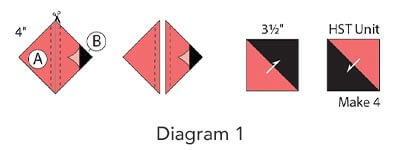
Referring to Diagram 1, draw a diagonal line on wrong side of (2) Fabric A 4″ squares. Place (1) Fabric A square over (1) Fabric B 4″ square. Sew a ¼” seam allowance on each side of drawn line. Cut in half on drawn line and press to make (2) HST Units. Trim to 3½” each. Make 224.
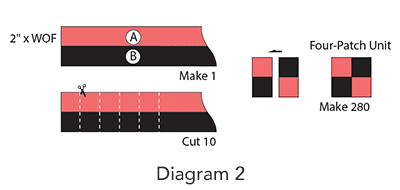
Paying attention to orientation, sew one each Fabric A and Fabric B 2″ x WOF strips to make strip set as shown in Diagram 2. Make (28) strip sets. Cut strip sets into (560) 2″ x 3½” pieced rectangles. Paying attention to orientation, sew 2 pieced rectangles together to make Four-Patch Unit. Make 280.
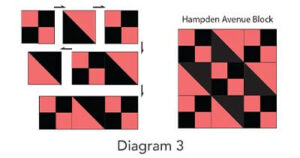
Paying attention to orientation, lay out (5) Four-Patch Units and (4) HST Units as shown in Diagram 3. Sew together into rows. Sew rows together to make Hampden Avenue Block. Make (56) Hampden Avenue Blocks.
Quilt Assembly and Finishing
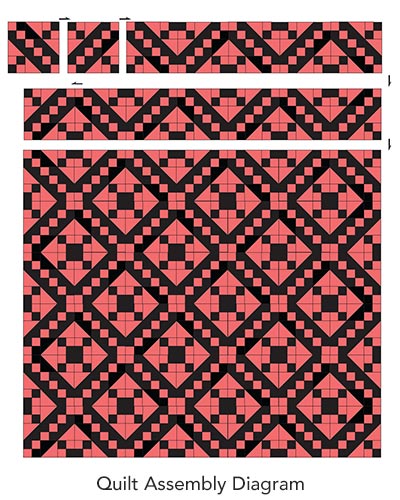
Referring to Quilt Assembly Diagram, lay out (56) Hampden Avenue Blocks in 8 horizontal rows, paying attention to orientation. Sew blocks together into rows. Sew rows together to complete Hampden Avenue Quilt.
- Trim selvage edges from 4¾ yards of backing fabric, fold yardage in half lengthwise, and cut into (2) 85½” x LOF pieces. Sew pieces together along LOF; press seam to one side.
- Center and layer backing, batting, and quilt top together to make a quilt sandwich; baste layers together and quilt as desired.
- Trim batting and backing even with quilt top.
- Using diagonal seams, make Fabric C binding from (7) 2½” x WOF strips. Fold binding in half lengthwise, matching wrong sides; press length. Sew binding to quilt top and miter corners; join binding ends as desired. Press binding away from quilt top and fold over quilt’s edge to back of quilt. Hand-stitch binding in place to finish. Quilt Assembly Diagram Diagram 3