
Bouncing Betty Quilt Pattern
DESIGNER:
Violet Robinson Edgemon
OWNED BY:
William P. Lother, II
DIFFICULTY LEVEL ‣ INTERMEDIATE
FINISHED QUILT SIZE:
81½” x 81½”
FINISHED BLOCK SIZE:
9″ x 9″
Bouncing Betty is also known as Crosses and Losses. Although the block is made up almost entirely of triangles, our method of cutting oversize squares that are then sewn together and trimmed to size ensures accuracy. It’s easy to get some of the triangle squares turned around in this quilt, although that certainly does not detract from its charm.
Instructions:
SPECIAL INSTRUCTIONS:
Read through entire pattern before beginning project. Use ¼” seam allowances with fabric right sides together. Pressing arrows are included with diagrams. Basic quiltmaking supplies are assumed. Fabric requirements include extra yardage for shrinkage and insurance, If working with directional prints, you may want to purchase more fabric than called for. Pattern based on an antique quilt and has been simplified as needed for ease of construction and may differ slightly from original.
WOF = width of fabric
LOF = length of fabric
HST = half-square triangle unit
FABRIC:
Fabric A: 5¾ yards solid white for blocks and binding
Fabric B: 3⅓ yards solid red for blocks
Backing: 6⅝ yards (for 45″-wide) or 3 yards (for 108″-wide)
ADDITIONAL SUPPLIES:
Batting: 93″ x 93″ piece
Marking pencil
CUTTING:
From Fabric A, cut:
• (12) 5½” x WOF strips. Cut strips into:
• (81) 5½” x 5½” squares.
• (14) 3¼” x WOF strips. Cut strips into:
• (162) 3¼” x 3¼”squares.
• (24) 2¾” x WOF strips. Cut strips into:
• (324) 2¾” x 2¾” squares.
• (9) 2½” x WOF strips for binding.
From Fabric B, cut:
• (12) 5½” x WOF strips. Cut strips into:
• (81) 5½” x 5½” squares.
• (14) 3¼” x WOF strips. Cut strips into:
• (162) 3¼” x 3¼” squares.
Backing:
If using 45″-wide backing:
• Cut (2) lengths, 2⅔ yards (or 96″) by WOF.
• From remaining 1 yard, cut:
• 3 strips, 12″ x WOF.
Block Assembly
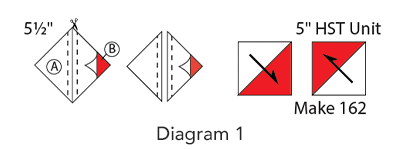
Referring to Diagram 1, draw a diagonal line on wrong side of (1) 5½” Fabric A square. Place Fabric A 5½” square over (1) Fabric B 5½” square. Sew a ¼” seam allowance on each side of drawn line. Cut in half on drawn line and press to make (2) HST Units. Trim to 5″. Make 162.
Referring to Diagram 2, draw a diagonal line on wrong side of (1) 3¼” Fabric A square. Place Fabric A 3¼” square over (1) Fabric B 3¼” square. Sew a ¼” seam allowance on each side of drawn line. Cut in half on drawn line and press to make (2) HST Units. Trim to 2¾”. Make 324.

Paying attention to orientation, lay out (2) Fabric A 2¾” squares with (2) 2¾” HST Units as shown in Diagram 3. Sew into rows. Sew rows together to make (1) Corner Unit. Make 162.

Paying attention to orientation, lay out 5″ HST Units with Corner Units as shown in Diagram 4. Sew into rows. Sew rows together to make Bouncing Betty Block. Make 81.

Quilt Assembly and Finishing
Referring to Quilt Assembly Diagram, sew together (9) Bouncing Betty Blocks to make a row. Make 9 rows.
Sew rows together to complete quilt top.

Trim selvage edges from (2) 96″ x WOF backing pieces. Sew (3) 12″ x WOF strips together end to end. Trim to 96″ long. Place 12″-wide piece between (2) 96″ x WOF pieces and sew pieces together along LOF; press seams to one side.
Center and layer backing, batting, and quilt top together to make a quilt sandwich; baste layers together and quilt as desired.
Trim batting and backing even with quilt top.
Prepare binding by sewing Fabric A binding strips together with diagonal seams; trim seam allowances and press seams open. Fold binding in half lengthwise, matching wrong sides; press length. Sew binding to quilt top and miter corners; join binding ends as desired. Press binding away from quilt top and fold over quilt’s edge to back of quilt. Hand-stitch binding in place to finish.
Violet Robinson Edgemon
Violet Robinson Edgemon (1918–2003) of Bessemer, Alabama, was an avid quilter and enjoyed gifting her quilts to family. This was one of the last quilts she made in the 1990s for her grandson, William (Bill) Patrick Lother, II.