
Welcome to Quilt Street!
Stella Quilt

Stella Quilt Pattern

DESIGNER:

Effie Ella Bryant 

OWNED BY:

Rhonda Lee Lother

DIFFICULTY LEVEL ‣ ADVANCED

FINISHED QUILT SIZE:

69″ x 87½” 

FINISHED BLOCK SIZE:

8⅝” x 10″ 

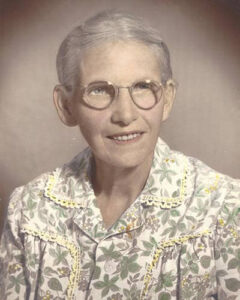
This quilt top was made by Effie Ella Bryant, great-grandmother of one of our editors, Rhonda Lee Lother. Effie lived in Stella, Arkansas, and was a prolific quilter who carded her own batting from cotton she grew on their farm. This was one of the last quilt tops she made in the late 1950s. The quilt top was passed down to Rhonda, who hand-quilted and finished the quilt. You can make this a portable project with English Paper Piecing. 

Instructions:

SPECIAL INSTRUCTIONS:

Read through entire pattern before beginning project. Use ¼” seam allowances with fabric right sides together. Pressing arrows are included with illustrations. Fabric requirements include extra yardage for shrinkage and insurance. If working with directional prints, you may want to begin with more fabric than called for. 

WOF = width of fabric 

LOF = length of fabric 


FABRIC:

Fabric A: 2½ yards total assorted print fabrics 

Fabric B: 2½ yards solid white 

Fabric C: 3¾ yards solid peach 

Fabric D: ¾ yard solid green 

Backing: 5½ yards (for 44/45″-wide) or 2¾ yards (for 108″- wide) 


ADDITIONAL SUPPLIES:

    •  Batting: 79″ x 97″ piece

    • Freezer paper

    • Scissors

    • Basting glue (optional)

    • 50 weight or thinner matching thread

    • #11 or #12 sharps needle for hand sewing 


CUTTING:

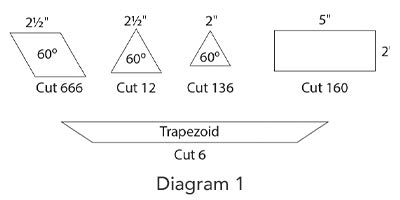
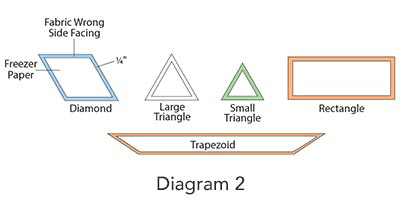
Using patterns provided, trace and cut templates without seam allowances from freezer paper. (Diagram 1). With shiny side of freezer paper against wrong side of fabric, press paper templates to pieces of fabrics, using a dry iron on the wool setting. Make sure fabric pieces extend at least ¼” beyond paper edge (Diagram 2). 

From Fabric A, cut: 

• 53 sets of 6 matching diamonds 

• 6 sets of 3 matching diamonds 

From Fabric B, cut: 

• 330 diamonds 

• 12 large triangles 

From Fabric C, cut: 

• 6 trapezoids 

• 160 rectangles 

• (9) 2½” x WOF binding strips 

From Fabric D, cut: 

• 136 small triangles 

QUILT STREET TIP:

Since English Paper Piecing (EPP) requires hand sewing, we recommend using a single strand of 50 wt. thread, knotted at the long end. EPP naturally creates seams that are “pressed” open, exposing the piecing thread. When it’s time to quilt the top, avoid a common quilting technique called “stitch in the ditch.” The sewing machine’s powerful force of the needle may break the threads between the seams.

Cutting Freezer Templates

Block Assembly

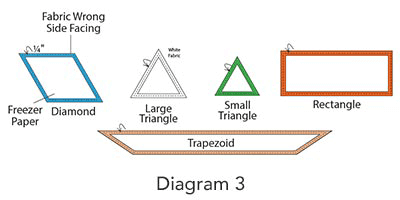
For each template, place paper side up and fold fabric seam allowance over paper edge as shown in Diagram 3. Lightly press. Using running stitch, baste seam allowance to wrong side, stitching through paper (if preferred, use basting glue instead of running stitch). 
Stella Quilt Block, Diagram 3

With right sides facing and folded edges aligned, whipstitch straight edges of 6 matching Fabric A diamonds as shown in Diagram 4. 

Stella Quilt Block, Diagram 4

Referring to Diagram 5, whipstitch sides of (6) Fabric B diamonds to Fabric A diamonds to form a hexagon. Press flat to complete Stella Block. Make 53. 

Stella Quilt Block, Diagram 5

In the same manner, whipstitch 3 matching Fabric A diamonds, (2) Fabric B diamonds, and (2) Fabric B large triangles as shown in Diagram 6. Press flat to complete Half Stella Block. Make 6. 

Stella Quilt Block, Diagram 6

To make Stella blocks and triangular-shaped sashing cornerstones, you will be working with bias edges, which can stretch and distort. Handle the patches carefully and press with an up and down motion rather than ironing with a sideways motion. 

Quilt Assembly and Finishing

1. Paying attention to orientation, lay out blocks, Fabric C rectangles, Fabric C trapezoids, and Fabric D small triangles as shown in Quilt Assembly Diagram.
Stella Quilt Block, Assembly

2. Whipstitch blocks and patches together. Remove freezer paper. 

  1. Trim selvage edges from 5½ yards of backing fabric, fold yardage in half lengthwise, and cut into (2) 99″ LOF pieces. Sew pieces together along LOF; press seams to one side. 

  2. Center and layer backing, batting, and quilt top together to make a quilt sandwich; baste layers together and quilt as desired. 

  3. Trim batting and backing even with quilt top. 

  4. Using diagonal seams, make Fabric C binding from (9) 2½” x WOF strips. Fold binding in half lengthwise, matching wrong sides; press length. Sew binding to quilt top and miter corners; join binding ends as desired. Press binding away from quilt top and fold over quilt’s edge to back of quilt. Hand-stitch binding in place to finish. 


    Tip: Make sure the binding isn’t attached too tightly to keep quilt edges from curling. 

    The quilt shown uses straight binding; you may opt to use bias binding to make sewing the inner angles a little easier. 
Effie Ella Bryant

Effie Ella Bryant

Effie Ella Bryant was born December 10, 1897, in Adair County, Kentucky. She and her husband, Charles M. Bryant, moved to Izard County, Arkansas, where they lived in several small towns, including Guion and Stella. Stella was a booming community in the 1920s with its own store and post office. Quilting was an important part of Effie’s life, and many of her quilts feature feed sacks that she no doubt obtained by purchasing goods in the local store. One of her granddaughters, Mona M. Richards, has fond memories of her quilting, and she inherited a few of the quilts and quilt tops after Effie passed on October 6, 1962. She and her daughter, Rhonda Lee Lother, completed the surviving quilt tops, of which this is one.

Shopping Cart
Scroll to Top