
Colonial Williamsburg’s Quilt Collection
Text by Phyllis Hoffman DePiano and Lorna Reeves
Photography Courtesy of Art Museums of Colonial Williamsburg

The Art of the Quilter exhibit at the Abby Aldrich Rockefeller Folk Art Museum features 12 different quilts annually from a collection of more than 350. Photograph Courtesy of The Art Museums of Colonial Williamsburg
Stepping onto Duke of Gloucester Street and experiencing the cobblestone street with the clip-clop sounds of horses’ hooves and the rattle of the carriages they pull, you feel as if you are transported back in time. The beauty of the houses, the gardens bursting with blooming flowers, and the neatly trimmed topiary trees and hedges all reflect the great pride that people had in their homes.
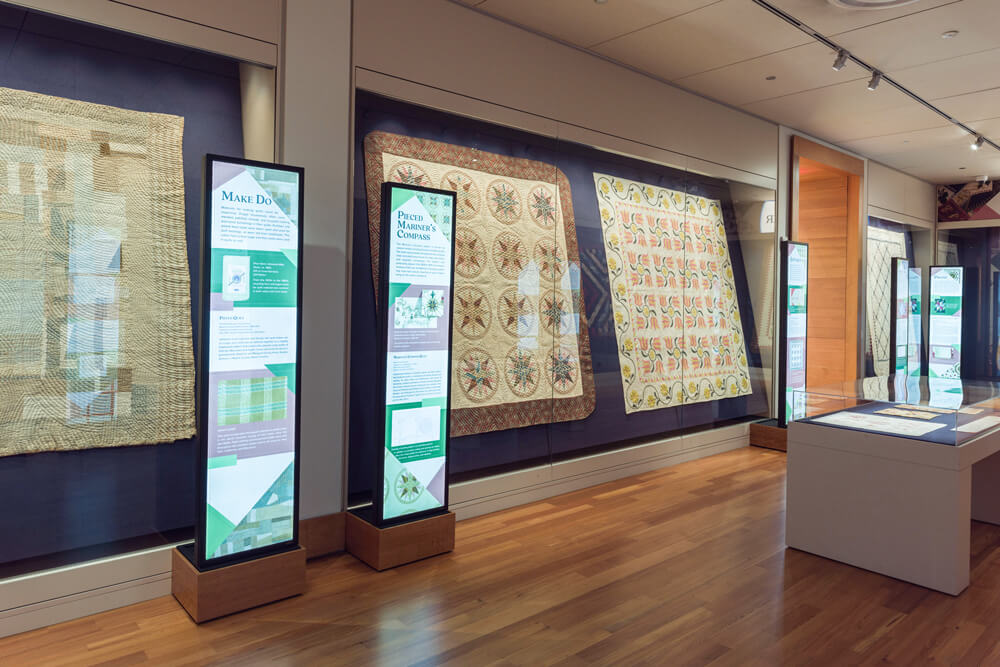
The annual rotation of quilts on display comprises set themes, such as appliqué, pieced, redwork, Mariner’s Compass, whitework, and hexagon, among others. Photograph Courtesy of The Art Museums of Colonial Williamsburg
Dedicated to preserving the past, The Colonial Williamsburg Foundation owns one of most exquisite collections of textiles. Included in it are gorgeous quilts dating to the 1600s. The newly renovated Abby Aldrich Rockefeller Folk Art Museum showcases some of these rare finds as well as others created as recently as the second half of the 20th century. Many of the more than 350 quilts in the collection were donated to the museum, while others were purchased by the museum.

Framed center medallion formats, like this one, were a popular design for appliquéd chintzwork quilts in the 1840s. Catharine Garnhart’s quilt made circa 1845, however, is unusual in her extensive use of reverse appliqué (sometimes called inlaid) for most of her floral sprays and all of her leaf vine borders. Catharine was the daughter of German immigrants living in Frederick, Maryland. She created quilts later in life for her 11 grandchildren. At least eight large quilts and three smaller crib-size quilts survive. Catharine made this quilt for one of her granddaughters, either Rebecca Bentz Markey Winebrenner or Susan Catharine Markey Rohrback.
Photograph Courtesy of The Art Museums of Colonial Williamsburg • Gift of David and Linda Davidson, 2022.609.8

An outer printed cotton border surrounds a pieced middle border that encloses the reverse appliquéd leaf vine border on Catharine Garnhart’s quilt.
Photograph Courtesy of The Art Museums of Colonial Williamsburg • Gift of David and Linda Davidson, 2022.609.8
The Art of the Quilter exhibit, which opened in 2021, celebrates American-made quilts. The exhibit rotates 12 quilts on display every year, most recently in August 2023, to represent a variety of techniques, colors, and materials. Each quilt expresses the imaginative artistic impulses of its maker(s) while also creating a warm and practical covering for loved ones. Some quilts were created as a community activity in which neighbors and relatives enjoyed the pleasures of working together and socializing. The quilts in this exhibit illustrate the multicultural nature of American society, including the Anglo-American, African American, German, Amish, and Mennonite communities.

This detail of a floral motif from the lower left of Catherine Garnhart’s quilt shows her skills with reverse appliqué as well as the surrounding quilting.
Photograph Courtesy of The Art Museums of Colonial Williamsburg • Gift of David and Linda Davidson, 2022.609.8

Shortly before her marriage to a successful Southern lawyer, 16-year-old Kate Tupper created this quilt in 1850 while living with her parents and three younger siblings in Charleston, South Carolina. The pattern, known as a Chimney Sweep, was a popular one for friendship and autograph quilts.
Photograph Courtesy of The Art Museums of Colonial Williamsburg • Bequest of Grace Hartshorn Westerfield, 1974.609.26

Kate Tupper signed and dated her quilt in ink in the top center half block.
Photograph Courtesy of The Art Museums of Colonial Williamsburg • Bequest of Grace Hartshorn Westerfield, 1974.609.26
“We can learn so much from our quilts and our quiltmakers,” says Kim Ivey, senior curator of textiles for The Colonial Williamsburg Foundation. “Studying a quilt is taking a highway back to the past to learn about what was important then, whether it was fashion or politics of the time.”
Spanning four centuries, a particular strength of the textile collection lies in quilts that women and some men constructed and decorated by piecing small bits of cloth together into geometric patterns or appliquéing cutout shapes onto a ground fabric. The hand stitches that held the finished quilt top to the warm inner batting and plainer backing fabrics added additional texture and subtle pattern.

This Amish log cabin quilt, which was purchased by the museum, is an unusual display of individuality rarely found in Amish quiltmaking, as evidenced by the rounded corners of the piece and the chosen pattern. Unlike many Amish quilts whose makers are anonymous, this quilt has a history of having been made for Mrs. John Lapp by her mother in Lancaster County, Pennsylvania, between 1890 and 1910.
Photograph Courtesy of The Art Museums of Colonial Williamsburg

The Log Cabin pattern is seldom found in Amish bed quilts of the late 19th and early 20th centuries, although it was a popular choice for other American quiltmakers. The inclusion of two logs of printed fabric is also atypical.
Photograph Courtesy of The Art Museums of Colonial Williamsburg
Quilt lovers are sure to find that The Art of the Quilter exhibit at the Abby Aldrich Rockefeller Folk Art Museum in Colonial Williamsburg truly is worth a yearly visit.
Phyllis Hoffman DePiano
Phyllis Hoffman DePiano was the founder of Quilt Street and Hoffman Media, LLC.