
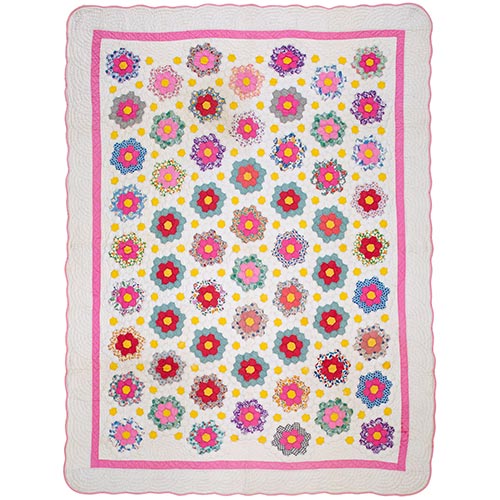
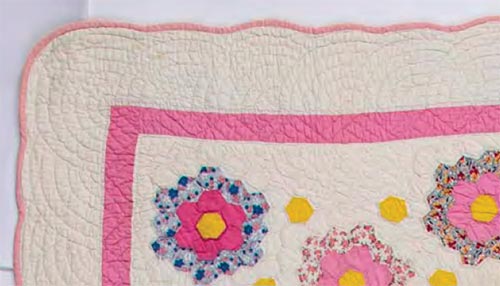
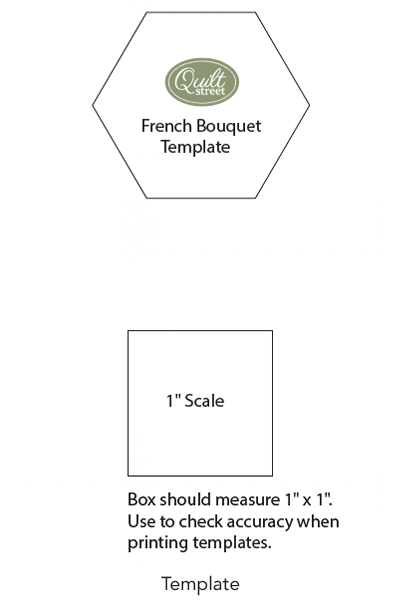
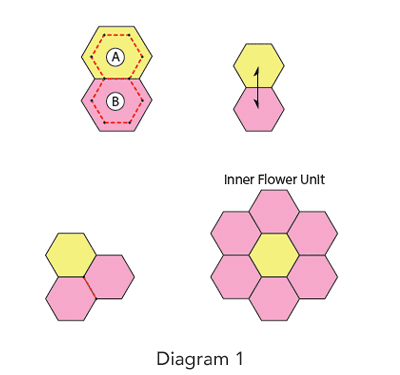
Trace finished size hexagon template onto cardstock, or use pre-purchased ¾” (on each side) paper piecing hexagons. Trace hexagon to wrong side of Fabric A. Cut around shape, adding a ¼” seam allowance. Fold seam allowance over cardstock edge and press. Baste seam allowance to wrong side, stitching through paper (if preferred, use basting glue instead of running stitch). Repeat for all hexagons. Choose (1) Fabric A hexagon, 1 set of (6) Fabric B hexagons, 1 set of (12) Fabric C hexagons, and (18) Fabric D hexagons. Referring to Diagram 1, place Fabric A hexagon over Fabric B hexagon with right sides facing and folded edges aligned. Whipstitch one edge and open. Add next Fabric B hexagon by whipstitching seam to Fabric A hexagon, then align and whipstitch to adjoining Fabric B hexagon. Repeat to form Inner Flower Unit.
Repeat with Fabric C hexagons to form Outer Flower Unit (Diagram 2).
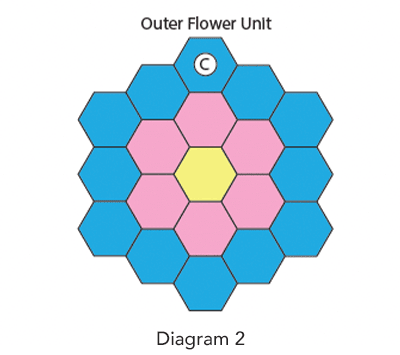
Repeat with Fabric D hexagons to complete French Bouquet Block (Diagram 3). Make 60 blocks in assorted Fabric B and C color sets with matching Fabric D hexagons.
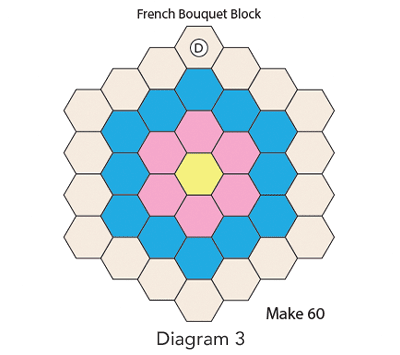
To make Flower Block A, add (2) Fabric A hexagons to (1) French Bouquet Block as shown in Diagram 4. Make 52.
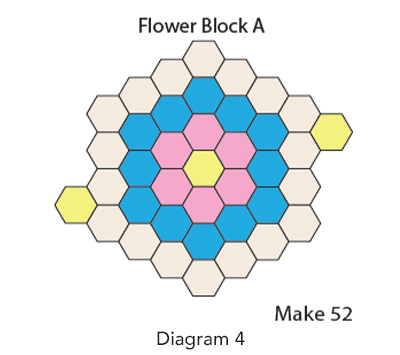
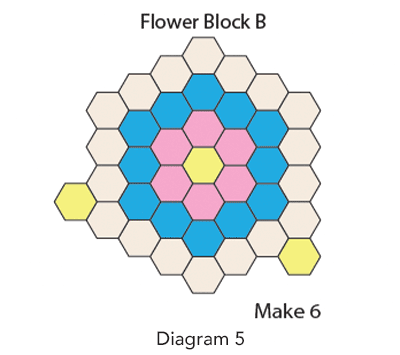
To make Flower Block B, add (2) Fabric A hexagons to (1) French Bouquet Block as shown in Diagram 5. Make 6.
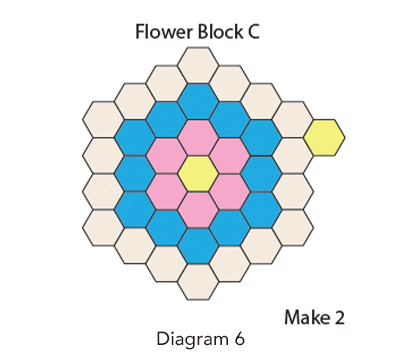
To make Flower Block C, add (1) Fabric A hexagon to (1) French Bouquet Block as shown in Diagram 6.
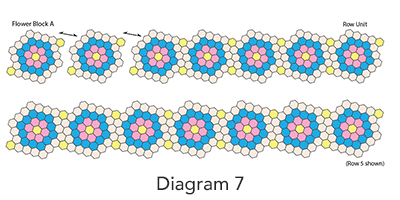
Referring to Diagram 7, lay out (7) Flower Block A as shown. Join to make 1 Row Unit. Row 5 is shown.
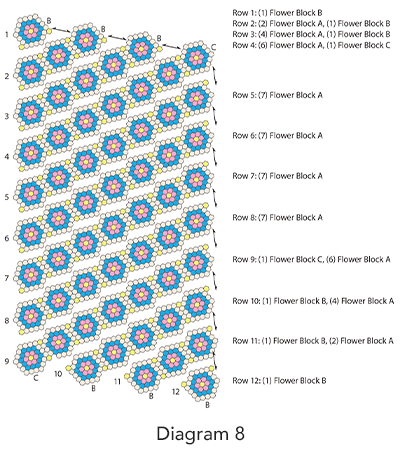
Paying attention to orientation and referring to Diagram 8, make 12 rows as shown. Join rows to make Center Unit.
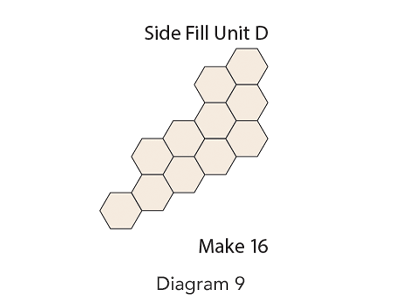
Referring to Diagram 9, join (11) Fabric D hexagons to make (1) Side Fill Unit D. Make 16.
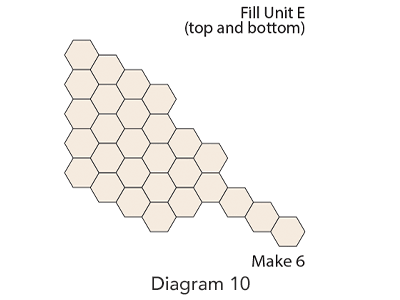
Referring to Diagram 10, join (28) Fabric D hexagons to make (1) Top and Bottom Fill Unit E. Make 6.
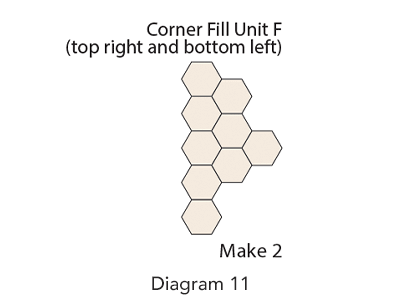
Referring to Diagram 11, join (9) Fabric D hexagons to make (1) Corner Fill Unit F. Make 2.
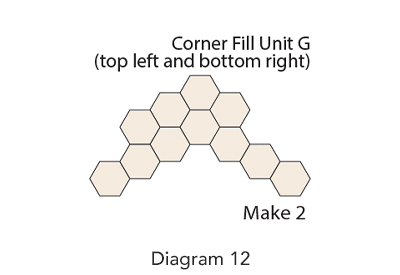
Referring to Diagram 12, join (11) Fabric D hexagons to make (1) Corner Fill Unit G. Make 2.
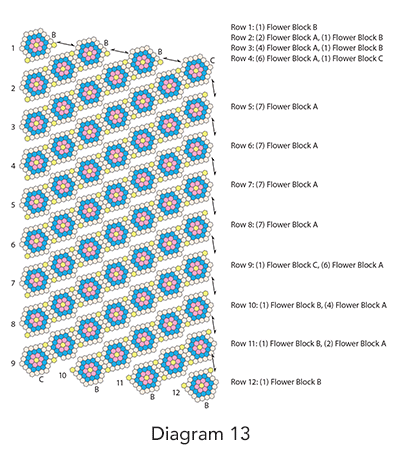
Lay out Fill Units D, E, F, and G with Center Unit as shown in Diagram 14. Join to complete Quilt Center. Remove paper pieces from quilt back. Trim quilt center evenly to 52¼” x 73½”.
Lay out Fill Units D, E, F, and G with Center Unit as shown in Diagram 13. Join to complete Quilt Center. Trim quilt center evenly to 52¼” x 73½”.
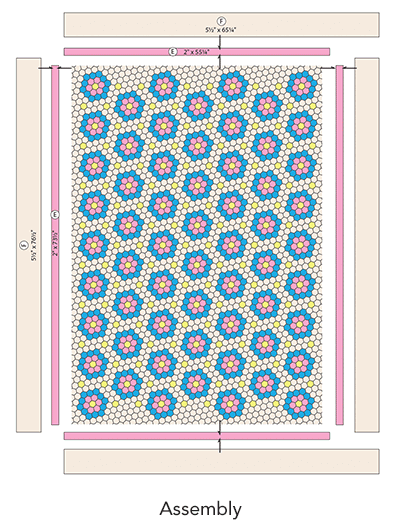
- Sew together (7) 2″ x WOF Fabric E border strips end-to-end to make one long strip. Cut strip into (2) 2″ x 73½” lengths. Sew lengths to each side of Quilt Center and press. Cut remaining strip into (2) 2″ x 55¼” lengths. Sew strips to top and bottom edges of quilt. Press toward Fabric E.
- Piecing end-to-end, sew together (8) 5½” x WOF Fabric D border strips to make one long strip. Cut strip into (2) 5½” x 76½” lengths. Sew lengths to each side of quilt top. Press toward Fabric D. From remaining Fabric D strip, cut (2) 5½” x 65¼” lengths. Sew strips to top and bottom edges of Quilt Center to complete French Bouquet Quilt Top.
- Trim selvage edges from 5½ yards of backing fabric, fold yardage in half lengthwise, and cut into (2) 2¾-yard x LOF pieces. Sew pieces together along LOF; press seam to one side.
- Center and layer backing, batting, and quilt top together to make a quilt sandwich. Baste layers together and quilt as desired.
- Trim batting and backing even with quilt top.
- Using diagonal seams, make Fabric E binding from (8) 2½” x WOF strips. Fold binding in half lengthwise, matching wrong sides; press length. Sew binding to quilt top and miter corners; join binding ends as desired. Press binding away from quilt top and fold over quilt’s edge to back of quilt. Hand-stitch binding in place to finish.